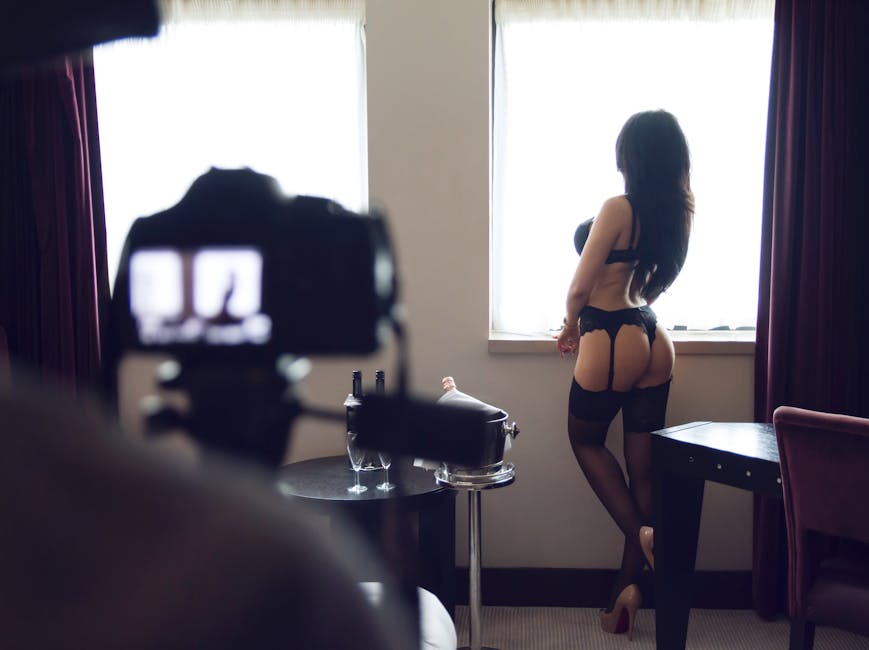
The hotel bar was called The Velvet Rope, and it earned its name. Deep burgundy walls, low amber lighting, armchairs so plush you sank into them like a warm bath. It was ten o’clock on a humid Tuesday – too late for business travellers, too early for the desperate – and I sat alone in a corner, nursing a whiskey that had gone watery from neglect.
I wasn’t looking for anything. That’s what I told myself. But my eyes kept drifting to the woman at the grand piano, not playing it, just leaning against its glossy black curve like she owned the silence between notes.
She was tall, with hair the colour of burnt honey, pinned up in a messy twist that had begun to unravel. Her dress was simple – charcoal silk, sleeveless, ending just above the knee – but on her it looked like something borrowed from a noir film. She held a martini glass by the stem, not drinking, just tracing the rim with her fingertip in slow, absent circles.
Our eyes met. She didn’t smile. She didn’t look away. She just tilted her head slightly, as if appraising a painting she hadn’t decided to buy yet.
I should have stayed in my chair. Instead, I stood up, walked to the piano, and sat on the bench beside her – not touching, but close enough to feel the warmth radiating from her bare arm.
“You’re not playing,” I said.
“I’m waiting for the right duet partner.” Her voice was low, a little rough, like bourbon left open overnight.
“What if I can’t play?”
She finally smiled – a slow, dangerous curve. “Then we’ll have to find another kind of rhythm.”
The lounge was almost empty. A bored bartender polished glasses behind the counter. A couple near the window argued in whispers. And behind the piano, partially hidden by a velvet curtain, I noticed something I hadn’t seen before: a small private dining room, its table pushed against the wall, leaving an open space. On that table sat a crystal decanter, two glasses, and a single candle flickering in a hurricane shade.
It looked less like a dining room now and more like a stage waiting for a performance.
She followed my gaze. “That room used to be a boudoir, you know. Before the hotel expanded. I read about it. They kept the mirrors.”
She stood and walked toward the curtain. Her heels made no sound on the thick carpet. She didn’t look back to see if I was following. That was the invitation – not a glance, not a word, just the knowledge that if I stayed on that piano bench, the night would end as it had begun: alone.
I followed.
The curtain brushed my shoulders as I stepped inside. She was right about the mirrors – three of them, floor-length, framed in tarnished gold, leaning against the walls at angles that caught the candlelight and multiplied it into a dozen tiny flames. The room smelled of beeswax and old wood and her perfume, which was jasmine and something darker, like smoke.
She stood in the centre, facing one of the mirrors, watching my reflection approach.
“This is where the chase begins,” she murmured, not turning around. “Or it ends. Your choice.”
I stopped a foot behind her. I could see her face in the mirror – the sharp line of her jaw, the pulse beating faintly at her throat, the way her lips had parted just slightly. She was watching me watch her. The air between us felt electric, compressed, like the second before a storm breaks.
“What are the rules?” I asked.
“No rules. Just don’t break the mirrors. Seven years’ bad luck, and I’m superstitious.”
I reached out and touched the back of her neck – lightly, just the tips of my fingers. Her skin was warm, almost feverish. She didn’t flinch, but her breath caught, and I saw her eyes close for a fraction of a second.
Then she turned.
Fast.
One moment she was facing the mirror, the next she was pressed against me, one hand on my chest, the other pulling the pins from her hair. The honey-coloured curls tumbled down over her shoulders. The candle flickered wildly. I caught her wrist – not hard, just enough to stop her – and she laughed, a low, throaty sound that vibrated through my ribs.
“You caught me,” she whispered. “Now what?”
The chase had shifted. We were no longer hunter and hunted. We were two people in a room full of mirrors, and every reflection showed a different version of us – closer, closer, closer. I slid my hand from her wrist to her waist, feeling the silk slide under my palm. She tilted her chin up, her mouth a breath away from mine.
“Now,” I said, “we find out if this room remembers what a boudoir is for.”
She pulled me down onto the chaise lounge that sat against the far wall – I hadn’t even noticed it, draped in velvet the colour of wine. We fell together into its cushions, her knees on either side of my hips, her hair forming a curtain around our faces. The candlelight danced across her cheekbones. One of the mirrors reflected us from the side – a tangle of limbs and silk and shadows.
She kissed me then. Not softly. Not tentatively. It was a kiss that tasted of martini brine and salt and something sweet underneath, like the last bite of a dark chocolate. Her fingers found the buttons of my shirt. My hands found the zipper of her dress. The sounds of the hotel – the distant elevator bell, the clink of glasses from the bar – faded into a muffled hum, as if the whole world had agreed to look away.
The chaise creaked. The candle guttere. In the mirrors, our reflections multiplied into infinity – a dozen versions of us, each one closer than the last, each one losing another piece of clothing, another breath, another pretence.
She whispered something in my ear – I won’t write it here, because some words belong only to the dark and the two people who share it – and I answered by pulling her tighter, burying my face in the curve of her neck, where her pulse raced like a trapped bird.
The chase was over.
What happened next didn’t need mirrors or candlelight or the ghost of an old boudoir. It needed only the heat of two strangers who had decided, for one night, that the hotel lounge was not a place for whiskey and polite conversation, but a stage for something far older and far less civilised.
Later – much later – we lay tangled in the velvet, the candle burned down to a stub, the room thick with the smell of sweat and jasmine and beeswax. Her head rested on my chest. One of her hands traced idle patterns on my stomach. The mirrors showed us a dozen peaceful versions, finally still.
“I never got your name,” she said.
“You never asked.”
She laughed again, softer this time. “Good. Then I don’t have to tell you mine.”
I kissed the top of her head. The first grey light of dawn was beginning to seep around the edges of the curtain. Somewhere outside, a taxi honked. London was waking up, oblivious to the fact that one of its hotel lounges had just been the backdrop for a very private kind of renovation.
I never saw her again. I never learned her name. But sometimes, on humid Tuesday nights, I find myself walking past that hotel, glancing up at the dark windows, and remembering the sound of a zipper, the weight of a stranger, and the way a room full of mirrors can turn a simple chase into something unforgettable.
And I smile.